
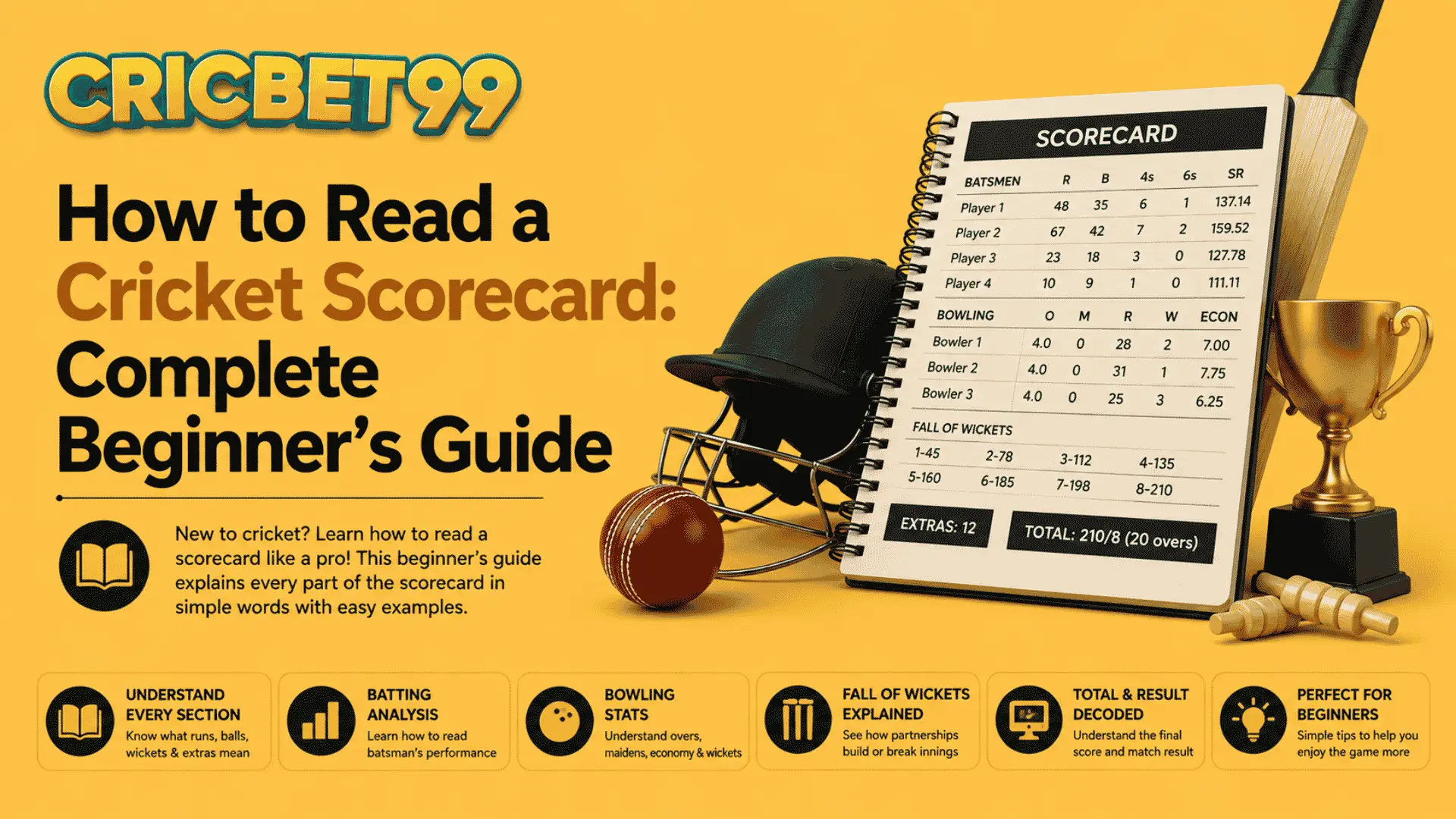
Cricket is a sport all around the world that is full of numbers, tactics and special strategies. A Cricket Scorecard is hard to appreciate without knowing what it is all about. A Cricket Scorecard assists fans, commentators, and players to see all the balls, all the runs, as well as all the wickets in a game. This guide will be a guide to a complete beginner on how to read a cricket scorecard. After reading, you will know very well what each part of the Cricket Scorecard means and how to follow the progress of your favourite team.
What is a Cricket Scorecard?
An official summary and continuous record of a match is a Cricket Scorecard. It is mainly intended to show what exactly is happening in the game at every moment. This assists the fans in keeping track of what is happening.
- Tracks match progress: It stores the history of the number of matches that have been won, which batters have been knocked out, and the overs that have been batted.
- Player performance: It displays both batter and bowler performances.
- Decision Making: Generally favourable to fans who are involved in online sports betting since it depicts real-time figures and historical trends of performance.
A Cricket Scorecard keeps all informed, whether it is a local game or an international tournament. It is important to know how to read a cricket scorecard to follow the action correctly.
Key Components of a Cricket Scorecard
In an attempt to simplify the Cricket scorecard, the key components of the scorecard need to be broken down. There are certain areas to concentrate on in a standard Cricket match scorecard.
- Innings: Displays the team in the middle of batting.
- Overs: A delivery is a legal six-ball over by a player.
- Runs: The number of points earned by the batting team.
- Wickets: The number of batsmen who have been dismissed (out).
Most betting websites such as Cricbet99 india use these vital measurements to deliver precise match updates. The analysis of Cricket scorecard statistics becomes a lot simpler with an understanding of these parts.
Cricket Scorecard Explained
A Cricket Scorecard looks different with regard to the format of the game. The data will be slightly different for a Test match, an ODI (One Day International) and a T20 match.
Format Differences Table:
| Format | Overs | Innings per Team | Importance in Scorecard |
| Test | Unlimited | 2 | Focus on wickets over time |
| ODI | 50 | 1 | Focus on steady run rates |
| T20 | 20 | 1 | High focus on strike rates |
A clear Cricket scorecard explained about a T20 match will be characterised by explosive runs, whereas a scorecard in a Test Cricket match will emphasise patience and collaboration. When making a Cricbet99 ID sign up, being aware of these format differences will aid in following live games more effectively. To learn to read a cricket scorecard, it is important to understand the format of a game in the first place.
How to Read a Cricket Scorecard
A Cricket Scorecard will seem like complex algebra to a beginner, but not hard to understand provided you know where to find the information. Your ultimate instructions on how to read a cricket scorecard are presented here.
- Check the Team Total: Typically shown as Runs/Wickets (e.g., 150/4).
- Scrutinise the Overs: e.g., 15.2 overs are 15 completed overs and 2 balls in the 16th over.
- Find the Batsmen on the Crease: See who is hitting now and his or her score.
- Check the Bowler: Enquire who bowls now, and what number of runs he has yielded.
By following these steps on the Cricbet99 app login or any live tracker, it is exciting to watch the game. It is by practice that one gets to know how to read a cricket scorecard second nature.
Common Cricket Scorecard Terms
In order to learn how to use a Cricket Scorecard, you need to be familiar with the common Cricket scorecard terms. Each Cricket match scorecard is based on such abbreviations.
- Runs (R): Runs scored.
- Wickets (W): Removals of the batting team.
- Overs (O): 6 balls bowled.
- Extras: Unscored by the bat (Wides, No Balls, Byes).
- Strike Rate (SR): How frequently a batsman scores a point.
These Cricket scorecard terms are important to know to understand any Cricket scorecard. These are the Cricket scorecard terms in use all over the world, and they form part of the Cricket scorecard statistics.
Understanding Cricket Match Scorecard Statistics
Cricket scorecard statistics give a better insight into the performance of players. By examining a scorecard of a Cricket match, statistics are the real story of the match.
- Batting Average: Sum of the runs/times put out.
- Economy Rate: Per over by a bowler.
- Strike Rate: Aggression when batting (Runs per 100 balls).
Statistics of good cricket scorecards indicate whether a player is in form or not. The more you know about the Cricket scorecard statistics, the better you know about the Cricket Scorecard.
Analysing a Sample Cricket Scorecard
We will take a simple example of the way the scorecard of a Cricket match is shown in a live scenario. An example Cricket Scorecard provides a useful perspective.
Sample Batting Scorecard Table:
| Batsman | Status | Runs | Balls | 4s | 6s | SR |
| Player A | Not Out | 45 | 30 | 4 | 1 | 150.0 |
| Player B | b. Bowler X | 12 | 15 | 1 | 0 | 80.0 |
Sample Insight: Player A is scoring in a hurry and has a high strike rate. Player B was bowled out by Bowler X. This is what it means to have the Cricket scorecard explained in practice.
The Evolution of Cricket Scorecards
Traditionally, a Cricket Scorecard was typed in huge, hardcopy scorebooks. The Cricket Scorecard has grown easy in transactions with digital technology today.
- Original scorecards were just handwritten documents.
- Live automated Cricket scorecard statistics are availed by modern graphics.
- Mobile access has enabled fans to access a Cricket match scorecard anywhere.
Digital innovation has provided the result that a Cricket Scorecard can be updated on a ball-by-ball basis so that no one can miss the game.
Conclusion
The knowledge of a Cricket Scorecard will also improve your overall watching experience. We have discussed the fundamentals of reading a cricket scorecard, the most important Cricket scorecard terms and how to interpret Cricket scorecard statistics. Cricket scorecard explained in an easy way enables anyone to get into the sport. Pull out a Cricket Scorecard and live-read one next time there is a match.
To find out more and see how you do in live games, visit cricbet99-ind to keep in touch with all the action!
FAQs
1. What does 150/4 mean on a Cricket Scorecard?
It implies that the batting side has had 150 runs and 4 wickets fell.
2. How do I learn how to read a cricket scorecard easily?
Begin with generalised data of the total number of runs, the number of lost wickets and the total number of overs bowled per run and only then move to the individual player statistics.
3. What are the most important Cricket scorecard terms?
The key terms are Runs (R), Wickets (W), Overs (O), Strike rate (SR) and Extras.
4. How is the batting strike rate calculated in a Cricket match scorecard?
It is determined by the number of balls faced in total runs scored and is multiplied by 100.
5. What is the difference between a Test and a T20 Cricket Scorecard?
A Test scorecard places emphasis on two innings and slower strike rates, whereas a T20 scorecard places emphasis on one rapid innings per team.
6. Where can I find live Cricket scorecard statistics?
Live statistics are available on the majority of major sports websites, official sports league sites, and television and radio stations.
7. Why is having the Cricket scorecard explained necessary?
Due to the numerous rules and variables in cricket. It is also possible to use the scorecard to follow the pace and momentum of the match.
8. What does “Extras” mean on a Cricket match scorecard?
Extras include those runs that were not hit by the bat of the batsman but by others like wides, no-balls and so on.
9. How do you track a bowler’s performance on a Cricket Scorecard?
You see their Overs (O), Maidens (M), Runs conceded (R) and Wickets taken (W).
10. Do Cricket scorecard terms change across different countries?
No, there are no universal terms and abbreviations of Cricket scorecards common to all international forms of the game.