
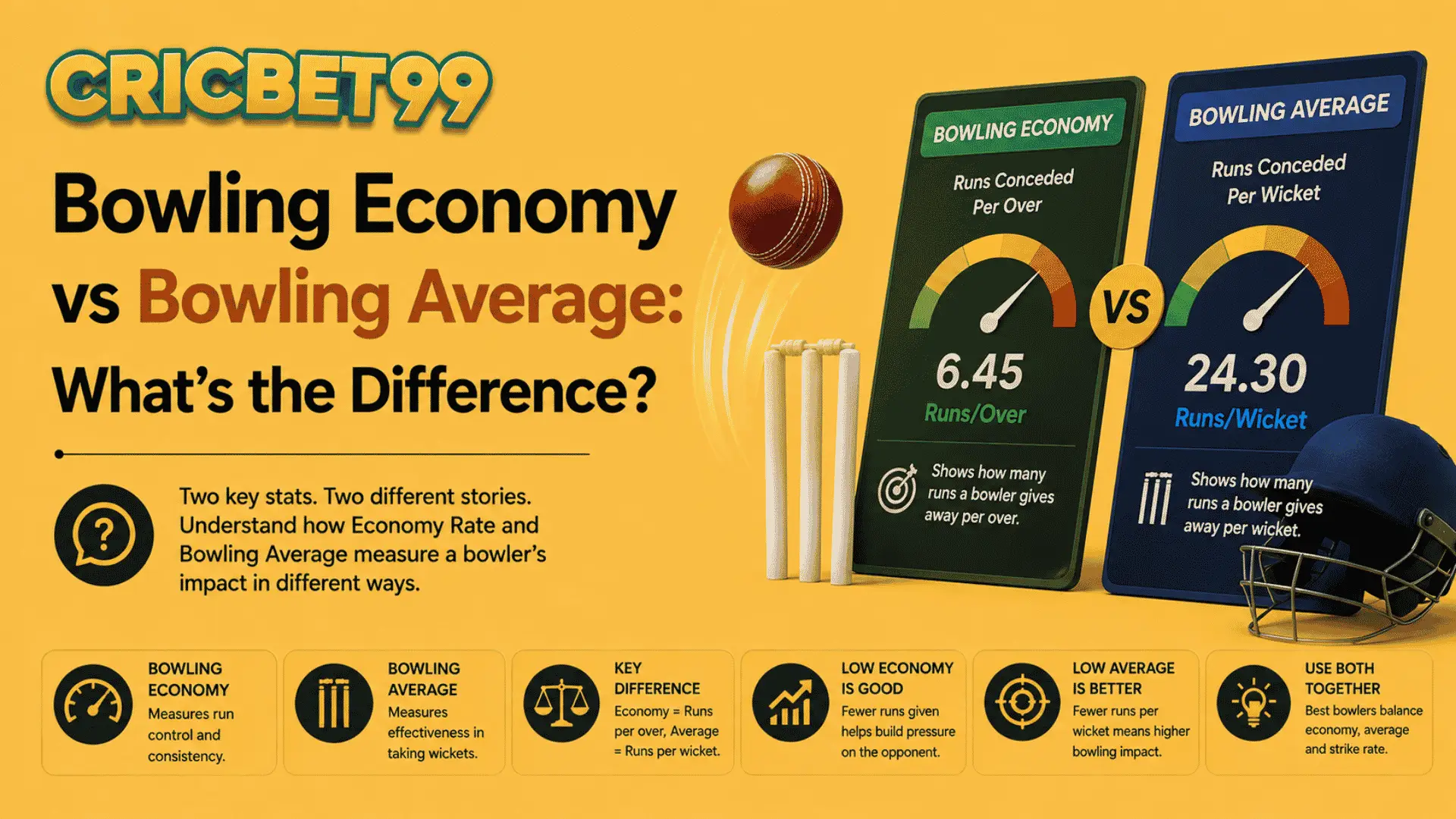
In the analysis of a cricket match, the fans tend to pay so much attention to the batting score, whereas the bowlers end up winning and losing the game. To determine the actual contribution of any given bowler to the game, it is quite crucial to comprehend Bowling Economy vs Bowling Average. As individuals review the general Cricket bowling stats, it is important to study Economy vs average, which gives two very different sides of the medal of a bowler: how many runs he or she gives and how frequently he or she gets out. This post aims at explaining these fundamental concepts in a straightforward language to enable you to enjoy the art of bowling.
Understanding Bowling Average
Bowling average in cricket is used to gauge the number of runs that a bowler concedes to each wicket. Each elite cricketer keeps a check on his or her Bowling average in cricket. Analysts compute this by using a Bowling average formula, which is the total set of runs conceded divided by the number of wickets taken. The Bowling average formula is easy to master with the knowledge of the overall runs and wickets. The fact that the formula for bowling average is known provides a clear understanding of the efficiency to strike when comparing Cricket bowling stats. Moreover, knowing Bowling Economy vs Bowling Average assists fans in understanding why this measurement is still the gold standard in red-ball cricket. Cricbet 99 website has excellent platform choices to offer to fans who would like to learn more about matches.
- Core Value: It shows the wicket-taking potency of a bowler.
- Better is Less Better: The lower the average, the few is the runs per dismissal.
- Application: Usage: crucial requirement in Test matches where 10 wickets have to be taken.
| Bowler Type | Primary Metric Focus | Typical Expectation |
| Strike Bowler | Wickets & Average | Low average (under 25) |
| Containment Bowler | Economy & Dots | Low economy (under 6) |
Understanding Bowling Economy Rate
The bowling economy rate informs us of the number of runs per over that a bowler makes. The major task of a coach when planning a match is to balance Economy vs average. This is calculated by dividing the total number of runs conceded by the total number of overs bowled. The bowling average formula is based on wickets and not on overs as in economy. To analyze Cricket bowling stats, without the bowling economy rate will only tell half the tale. In comparing Bowling Economy vs Bowling Average, the differences between containment and aggression are highlighted.
- Scoring Pressure: The scoring rate is high, which starves batters of easy runs.
- Format Significance: Critical in T20s and in ODIs, with each ball being counted.
- Control: Demonstrates discipline and line and length control of a bowler.
The Key Differences Between Economy and Average
In comparing Bowling Economy vs Bowling Average, what you realise is that they measure two different skill sets. Whereas in economy, restriction is tracked, average tracks wicket-take. Bowling Economy vs Bowling Average studies will show that various match conditions require various roles in bowling. When you manage your predictions on the matches, it is useful to have a Cricbet99 ID provider which enables you to analyse the forms of the players better.
Direct Comparison:
- Economy Rate: Calculates the number of runs per over (important in white-ball cricket).
- Bowling Average: Measures the number of wickets (important in red-ball cricket).
- Bowling Economy vs Bowling Average is a complete statement of performance when considering Cricket bowling stats.
The Role of Context in Bowling Stats
Conditions in matches would radically alter the outputs of the players. Pitch shift, weather and form of the game modify economy and average. The mathematical laws which govern the Bowling average formula are not affected by external conditions but are very much affected by these conditions. To compute Economy vs average, it is necessary to go beyond simple numbers to comprehend the external match pressures. Bowling average in cricket for spinners is enhanced by pitch degradation with the progress of the game. To protect a low aggregate, low-value bowlers are compelled to assault, which influences the Cricket bowling stats. Knowing the meaning of Bowling Economy vs Bowling Average will help eliminate confusion about the real ability of a bowler.
- Pitches: Green pitches are more popular with fast bowlers, which decreases their average.
- Boundaries: Small grounds swell the bowling economy rate.
- Weather: Humidity and dew change the grip of the ball, and vary the run rates.
Analysing Bowling Economy vs Bowling Average in Different Formats
When it comes to different formats, the priorities are different. In Tests, the king of Bowling average in cricket is the one who takes 20 wickets to win a match. In T20s, a tight bowling economy rate wins games. Whereas test cricket concentrates on wicket-taking through the use of the Bowling average formula, limited-overs concentrate on maintaining the rate of the bowling economy. Economy vs average changes entirely from red-ball to white-ball cricket. A comparison of Bowling Economy vs Bowling Average in today’s leagues shows that players have to be flexible. In order to keep the match action, it is quite convenient to use the cricbet99 Apk download.
- Test Cricket: Economy is valued less than average.
- Limited-Overs: High strike rates give way to low economy.
- A review of Cricket bowling stats in the various formats shows that no single value can be used to determine greatness.
| Format | Key Priority Metric | Why It Matters |
| Test Cricket | Bowling Average | Teams need 10 wickets to win |
| T20/ODI | Economy Rate | Restricting boundaries limits totals |
Case Studies: Cases of Bowlers of Note and Bowling Statistics
A glance at legendary players elucidates these measures. Using Bowling Economy vs Bowling Average for the icons reveals that various styles are successful. Players such as Sunil Narine have a phenomenal bowling economy rate, and there are legendary players such as Glenn McGrath with a legendary bowling average in cricket. The greats of the past excelled since the output of their career oriented towards the bowling average formula. Bowlers who have mastered the bowling economy rate choke opponents’ scoring. Bowlers who are dependent on a good bowling average formula shoot early. Learning to play Bowling Economy vs Bowling Average is what distinguishes between good bowlers and those who are all-time great. There are case studies of the difference between Economy vs average on icons.
- Cost-effective Experts: Major in dot balls and field placements.
- Strike Bowlers: Sheriff attacks the stumps to be erroneous.
The Impact of Bowling Styles on Economy and Average
Bowling styles directly affect the performance measures. Selection of fast bowlers, medium pacers, and spinners all influence Crime statistics of bowling in different ways. There are varying bowling styles that give different results when the formula of bowling average is used. Viewing Bowling Economy vs Bowling average using styles explains the reason behind mixed pace and spin teams. In cricket, fast bowlers take advantage of a high Bowling average in cricket and will be happy to receive increased run flows. Spinners tend to have a brilliant economy in the middle overs of bowling. Medium pacers depend much on changes so as to maintain Economy vs average balance. To easily manage the account and see real-time statistics, visit the cricbet99 id login page.
- Fast Bowlers: Rapid, violent, very high strike rates.
- Spinners: Turn and fly, great middle-over economy.
- Medium pacers: Cut-and-swing planes.
The Evolution of Bowling Metrics in Cricket
The means of cricket data analytics have come a long way from scorebooks to complex model data. Historically, following Bowling Economy vs Bowling Average reveals how the sport has been speeding up. Advanced Cricket bowling statistics are also used by modern teams to forecast which team will win a match. Modern coaches rely on anticipated economy and dot-ball percentages and the formula of bowling average. High-level analytics reshaped the perspective of Economy vs average in franchise leagues by the analysts. To participate in community-based debates on the analytics of cricket, go to the Cricbet99 club vip.
- Historical Diversion: Earlier, cricket was only concerned with the fundamental runs and wickets.
- Control and pressure: Measures of data tracking are modern.
- Trends in the future: AI is used to optimise bowling strategies on-the-fly.
Conclusion
To conclude, the slew of Bowling Economy vs Bowling Average provides a profound understanding of the dynamics in cricket. The rate of the bowling economy serves to measure the run restraint, and the bowling average in cricket serves to measure the wicket efficiency. The Economy vs average will only contribute to the appreciation of each tactic in the field by the fans. In the end, Bowling Economy vs Bowling Average has become the most reliable method of assessing player excellence, and immersing into the Cricket bowling statistics can add enjoyment to the game.
Are you prepared to improve your knowledge in the field of cricket and to use the platforms of interesting matches? Join Cricbet99 today at ICricbet99 to see live updates and statistics!
FAQs
1. What is the main difference between economy and average?
Economy measures are those given on a per-over basis, and average measures are those given on a per-wicket-taken basis.
2. Why is the bowling economy rate important in T20 cricket?
T20 games have fewer overs, and run inhibition is extremely important to ensure the opposing team is not allowed to record huge scores.
3. Which format values bowling average in cricket the most?
They also attach a great deal of importance to bowling average since it is only possible to win matches by bowling out the opposition twice.
4. Can a bowler have a great economy rate but a poor average?
Yes, defensive bowlers can also limit run without lots of wicket without taking many wickets.
What is considered a good economy rate in T20 matches?
Below 7 runs per over is generally termed as extraordinary in T20 cricket.
5. How do match conditions affect cricket bowling stats?
Weather, pitches and boundary size are crucial determinants of the number of runs bowlers concede, and the number of wickets they claim.
6. Why do spinners usually have better economy rates in limited overs?
In the middle overs, spinners concentrate on dot balls and short lengths because field restrictions are eased off.