
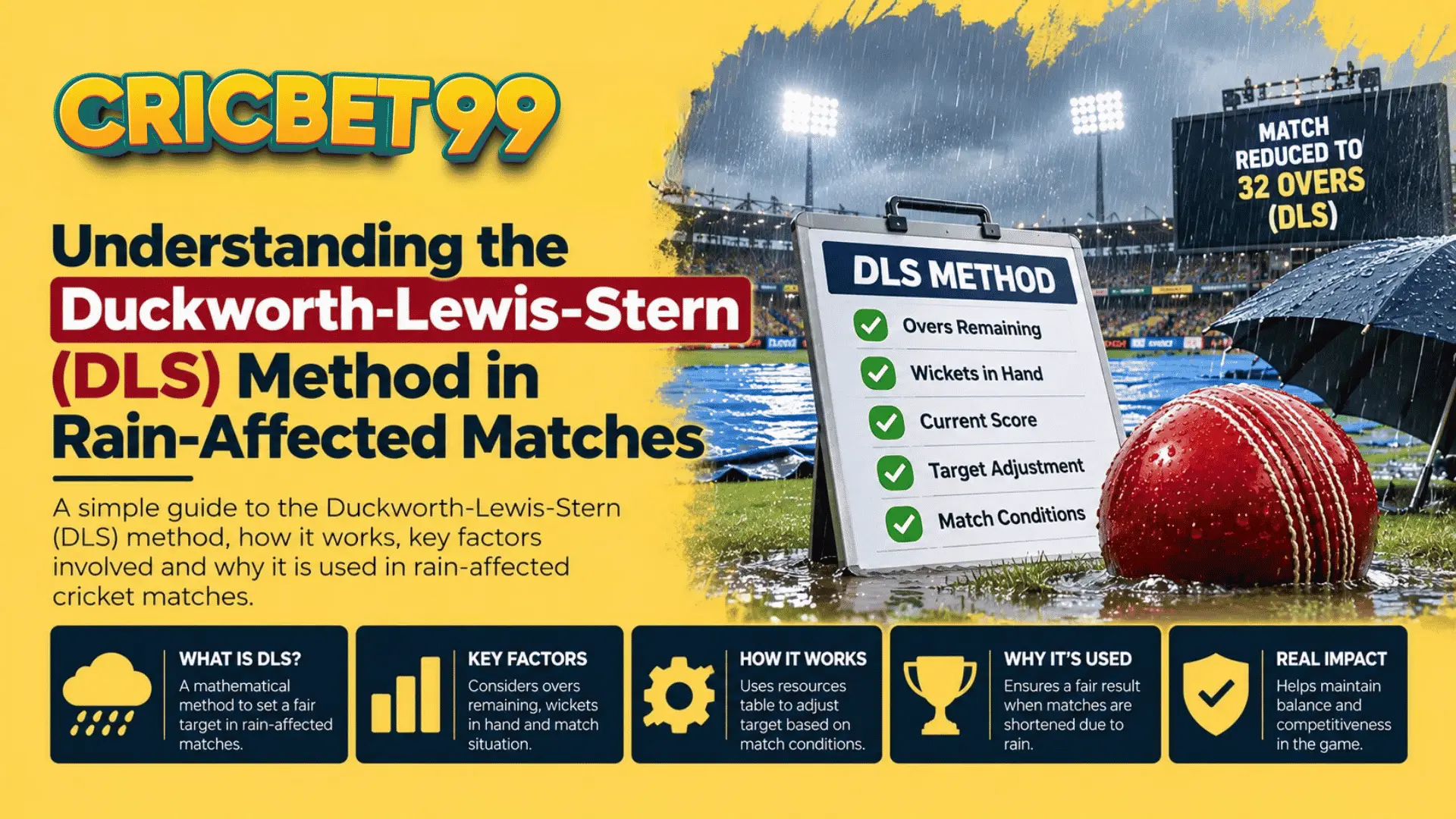
Rain can stop a match at any time. Then fans ask one thing. What is the new target? The Duckworth-Lewis-Stern (DLS) Method gives the answer. It sets a fair score when overs are lost. It also shows how rain affected cricket matches still get a fair result.Cricbet99 is a cricket site that shares easy guides and match news. It helps fans learn rules like this one before the next game.
What Is the Duckworth-Lewis-Stern (DLS) Method ?
The Duckworth-Lewis-Stern (DLS) Method is a way to do the math. Match officials use it when rain cuts a game short. The DLS method in cricket sets a new target for the team that bats second. It also fixes the chase if rain stops play in the middle of it.
The aim is simple. Both teams get a fair chance, even with fewer overs. Think of it as a fair trade. Lost overs mean a lower target.
Why Cricket Needed a Rain Rule
Old rules were not fair. Some used the average runs per over. Others dropped the weakest overs of the first team. A side could win or lose for no good reason.
The Duckworth-Lewis-Stern (DLS) Method came to fix this. Before it, many rain affected cricket matches ended in anger. Fans and players wanted a clear and fair way. They wanted a result that matched the play on the field.
Who Made It and How It Grew
Two men from England made the first version. They were Frank Duckworth and Tony Lewis. The ICC began to use their work in 1999. Later, a professor named Steven Stern took over. In 2014, the name changed to Duckworth-Lewis-Stern.
That is Duckworth Lewis Stern explained in a few lines. Stern changed the tables to suit today’s games.
The Two Things That Matter
The Duckworth-Lewis-Stern (DLS) Method looks at how much batting power a team has left. A DLS calculation in cricket starts with two simple things.
Overs Left
More overs mean more time to score. A team with all 50 overs has full power.
Wickets in Hand
More wickets mean batters can hit hard. Fewer wickets mean they must play safe.
Why They Work Together
A team with ten wickets and ten overs left is strong. A team with two wickets is weak. This is true even if many overs are left.
What Rain Changes
Rain takes overs away. The batting power left goes down. So the target goes down too.
How the DLS Calculation Works Step by Step
The DLS calculation in cricket is done by a computer program. Officials type in the overs lost and the wickets down. The program then gives the revised cricket target.
Here are the steps:
- Find how much power the first team had.
- Compare both.
- Change the first score by that gap.
- Add one run. That is the target to win.
A Simple Example in a Table
Say Team 1 scores 280 in a 50-over game. Then rain cuts the chase. The Duckworth-Lewis-Stern (DLS) Method gives Team 2 a lower goal. The numbers below are only rough. The real revised cricket target comes from the official program.
| Overs for Team 2 | Power left (about) | Target (about) |
| 40 | 89% | 251 |
| 30 | 75% | 211 |
| 20 | 57% | 159 |
Fewer overs mean a smaller target. But the drop is not even. Early overs are worth more than late ones.
Rules in ODIs and T20s
Each type of game has its own limits. Fans who read trusted sports betting news often check these points. A new target changes how a game feels. The DLS method in cricket follows these basics:
- In an ODI, each team needs at least 20 overs for a result.
- In a T20, each team needs at least five overs.
- The target changes each time play stops again.
- A par score is the score the chasing team needs at each stop.
- If both scores are level at par and play ends, the game is tied.
Common Complaints and Fixes
Some fans say the method is hard to follow. Others feel it helps one side. A few say the math is hidden. These doubts are fair. Some say the first innings is over, so a reset feels odd. Yet the method uses the whole first innings as its base.
The Duckworth-Lewis-Stern (DLS) Method is not perfect. Still, it is far better than the old rules. In rain affected cricket matches, it is the best tool the game has today. TV channels now show the par score on screen. That makes the chase easy to read.
Famous Rain Matches
True stories help here. This part keeps Duckworth Lewis Stern explained with facts from the field.
The 1992 World Cup semi-final is the best known one. South Africa needed 22 runs from 13 balls. Then rain came. The new target was 22 runs from one ball. The rule was changed after that.
In 2003, South Africa and Sri Lanka tied a World Cup game in Durban. The home side read the par score wrong. They thought they had won. They had not. The Duckworth-Lewis-Stern (DLS) Method was fine. The error was in the reading. Both games show why reading matters.
Tips for Fans
Fans can follow rain games with ease. Try these tips:
- Note when the rain starts and how many wickets are down.
- Check the par score after each stop.
- Watch the screen for the new target.
- Learn the two things that matter.
- Trust the official scorecard.
- Visit the Cricbet99 official site for simple cricket guides.
A basic DLS calculation in cricket can also be checked with free tools online. They give close numbers in seconds.
Why Fair Targets Matter
A fair target keeps the game honest. Players bat and bowl with clear goals. Without a clear revised cricket target, rain would decide too many games.
The DLS method in cricket gives every team a fair chance. That is why it stays in use.
Conclusion
Rain will always be part of cricket. The Duckworth-Lewis-Stern (DLS) Method makes sure it does not ruin the game. It gives both teams a fair goal. Next time the rain stops play, check the par score.
Cricbet99 aims to make cricket rules easy for every fan. It keeps its guides short, clear and simple to use.
FAQs
1. What is the DLS method?
The Duckworth-Lewis-Stern (DLS) Method is a way to set a new target. It is used when rain cuts a match short.
2. Who made the DLS system?
Frank Duckworth and Tony Lewis made it. Steven Stern took over later. The name changed in 2014.
3. Can you sum it up in one line?
Here is Duckworth Lewis Stern explained in one line. It checks the batting power of both teams and sets a fair target.
4. How many overs are needed for a result?
An ODI needs 20 overs for each team. A T20 needs five overs for each team.
5. Is the method always fair?
Not always. Yet it is fairer than the old rules. It looks at overs and wickets together.