
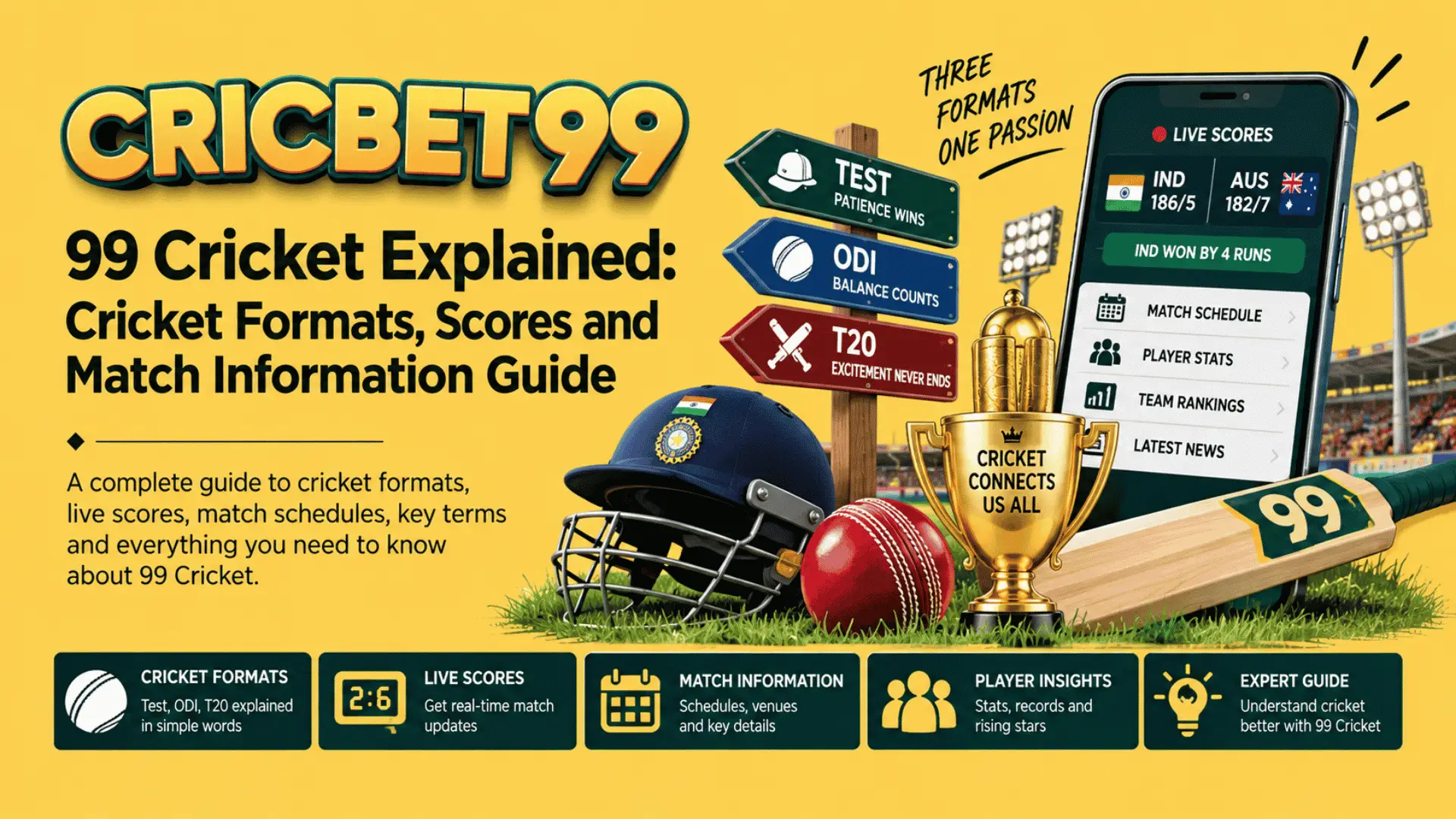
Cricket unites millions of fans all over the world. To get clear view with cricket, you have to be aware of its rules, structure, and live statistics. In this 99 Cricket Explained article, you can find the information about every important thing in the sport. The game format, scoring methods, and match analysis will be discussed.
If you observe any big match or read cricbet99 black updates, you should know how players score points in the sport.
What is 99 Cricket?
99 cricket refers to straightforward rules and live data points that allow following every ball in the match. Modern games require quick updates for fans to avoid missing any point or wicket.
For easy tracking of the live games, you can use various platforms such as official cricbet99 for observing local and international matches.
The Three Main Cricket Formats In 99 Cricket Explained
Teams play international cricket in three main formats. Each format has its own speed, plan, and match length.
1. Test Cricket
Cricket’s oldest format is test cricket. Matches run the longest too. It tests team skill and patience over five full days.
- Duration: Up to 5 days with two turns per team.
- Overs: Unlimited, with a minimum of 90 overs bowled per day.
- Strategy: Score lots of runs batting and take 20 wickets.
2. One Day International (ODI)
ODI cricket is the mix of both the tactics of test cricket and the pace of short cricket games.
- Time: About 8 hours on one day.
- Number of Overs: 50 overs per team.
- Key strategy: Maintain a consistent rate of scoring runs but keep wickets safe at the end.
3. Twenty20 cricket (T20)
T20 cricket is the fastest-paced form of cricket which gave popularity to league cricket.
- Time: About 3 to 4 hours in total.
- Number of Overs: 20 overs per team.
- Key Strategy: Hit hard from the start to build high total cricket scores.
Understanding Cricket Scores and Runs
Run scoring is possible when batters hit the ball and run between the two wickets or touch the boundary ropes.
Scoring Runs Techniques
- Four: Ball hits the ground and flies past the boundary rope.
- Six: The ball is hit over the boundary rope without touching the ground.
- Wide Ball: The ball that is thrown beyond the reach of the batsman.
- No Ball: The ball that is thrown above the head of the batsman.
- Leg Bye/Byes: Runs scored when the ball fails to hit the bat and touches the body.
How Wickets Fall
There are a number of ways by which bowlers and fielders can dismiss the batter:
- Bowled – The ball strikes the wooden stumps and dislodges the upper bails.
- Leg Before Wicket (LBW) – The ball strikes the leg in front of the stumps.
- Run Out – A fielder hits the stumps when the batter runs outside the line.
- Stumped – The wicket keeper dislodges the bails when the batter comes outside the crease.
Key Information Guide for Matches
| Feature | Test Cricket | ODI Cricket | T20 Cricket |
| Total Overs | Unlimited | 50 per side | 20 per side |
| Match Duration | 5 Days | 1 Day | 3.5 Hours |
| Clothing | Traditional Whites | Colored Kits | Colored Kits |
| Ball Color | Red or Pink | White | White |
| Powerplays | None | 3 Phases | First 6 Overs |
When watching live cricket, keep an eye on the run rate. Watching current run rates shows which team has the lead.
Types of Pitches and Weather
Pitch inspection has an important bearing on the planning of matches in all cricket formats. The pitch state helps a captain choose to bat or bowl after the toss.
Green Pitches
A green pitch has fresh grass on top of the soil. Grass holds moisture and helps fast bowlers curve the ball early on.
Dry and Dusty Pitches
Dry pitches crack as the game goes on in warm weather. These cracks slow down fast balls but help spin bowlers turn the ball sharply.
Flat Pitches
Flat pitches give very little help to bowlers. The ball comes to the bat easily, making it simple for batters to score big runs.
How Rain and Bad Light Affect Matches
The weather condition is very important when playing cricket outdoors. For example, rain or bad lighting can lead to interruption in the game for the players’ safety.
In cases where there is heavy rain and the game has to be stopped halfway, then DLS method is applied. The system calculates a new target for the batting team. If rain washes out a game early, it ends in a no-result.
Bad light also stops play. Umpires use light meters to test visibility on the pitch. If the field gets too dark to see fast balls, players leave the field. Rain delays force captains to change plans quickly. Teams must score faster or bowl tight overs to win before rain returns.
Player Roles on the Field
Each member of the team is assigned a particular role to assist in the victory of the game.
- Opening Batsmen: Receive the new ball, refrain from making early shots and build a good base for the innings.
- Middle Order Batsmen: Protect their team from early wickets and help improve the run rate.
- All Rounder Players: Good players who can play both batting and bowling very well.
- Wicket Keepers: Position themselves behind the stumps to catch the balls, stump runs and set up the fielders on the field.
- Fast Bowlers/Bowlers: Throw the ball fast and vary their techniques.
- Spinners: Bowl the ball slowly so that it confuses the batting team.
Managing Injured Players and Replacements
In case of injury to any player during the game, there are rigid rules for replacing him. A basic substitute fielder can run and catch balls for an injured player. However, that substitute cannot bowl, bat, or act as team captain.
An exception exists for head injuries. If a batter suffers a concussion from a ball hit, teams use a concussion substitute. This replacement player can bat and bowl fully for the rest of the match. Players are first examined by medical personnel on the field before allowing them to resume playing.
Workload levels are kept an eye on by fitness coaches so that there will be no muscle damage caused during busy tour periods. Keeping players healthy ensures teams field their best lineups for crucial matches.
Changes in Modern Game Rules
Game leaders added new rules over time to make matches faster, fairer, and cleaner for fans to watch.
The Decision Review System (DRS)
Teams can use DRS to evaluate umpire calls through camera and microphone sensors. Each team gets a fixed number of missed checks per game.
Powerplay Rules
Powerplays limit how many fielders stand outside the inner ring during early overs. In T20s, the first 6 overs allow only two fielders outside.
Free Hits
When a bowler steps over the line for a no-ball, the next ball becomes a free hit. Batters cannot get out on free hits.
Smart Ways to Read Match Stats
Tracking live games goes beyond counting basic runs. Analysts look at key details during every match.
- Strike Rate Batting: Tells how quickly a batter scores runs by looking at the number of balls they face.
- Economy Rate Bowling: Tells how many runs a bowler gives up on average every over they bowl.
- Dot Ball Percentage: Measures how many balls score zero runs to build pressure on batters.
- Control Percentage: Shows how clean a batter hits the ball without missing or edging.
Following Matches on Mobile Apps
Modern fans use mobile sites to get real-time scores and stats. Fans tracking match panels can use the cricbet 99 club or log into to see clear score updates for every ball.
Why Following 99 Cricket Helps Fans
Having a clear 99 Cricket Explained guide helps new fans learn key match rules easily. Knowing how formats differ helps you see why teams play carefully in Test matches but hit hard in T20s. Completing a quick cricbet99 sign up lets fans connect to live data streams.
Tracking live cricket scores in real time lets you follow every single run, wicket, and boundary as it happens.
Summary
This guide on how to Play 99 Cricket provides all information on how games are played, how runs are scored, and how game structures affect the strategies of teams. From 5-day test cricket to 20-over T20 games, everything about rules is fun in action.
With match analysis tools at your disposal, you will always remain up-to-date with the latest scores and statistics in 99 Cricket Explained. You can also xman247 online to check the live streams.
Frequently Asked Questions (FAQ)
1. What aspects are covered by the 99 Cricket Explained guide for new fans?
The 99 Cricket Explained guide gives explanation of basic rules, fielding positions, run-scoring and distinctions between Test, ODI and T20 games.
2. What are the distinctive features of various cricket formats?
The distinguishing features are match duration and over limit. Test matches take place for 5 days, ODIs include 50 overs and T20 matches are played for 4 hours.
3. What are the restrictions on the number of overs that a single bowler is allowed to bowl?
In case of T20 matches a bowler can play up to 4 overs. In case of 50 over ODI matches a bowler can play up to 10 overs.
4. From where can I obtain real-time cricket scores while playing cricket?
One can obtain real-time cricket scores through official sports sites, scoreboards, and sports applications on mobiles.
5. How can I keep myself updated with live cricket statistics on my mobile?
One can follow live cricket games through scoreboards, score alerts, and mobile dashboard for stats.