
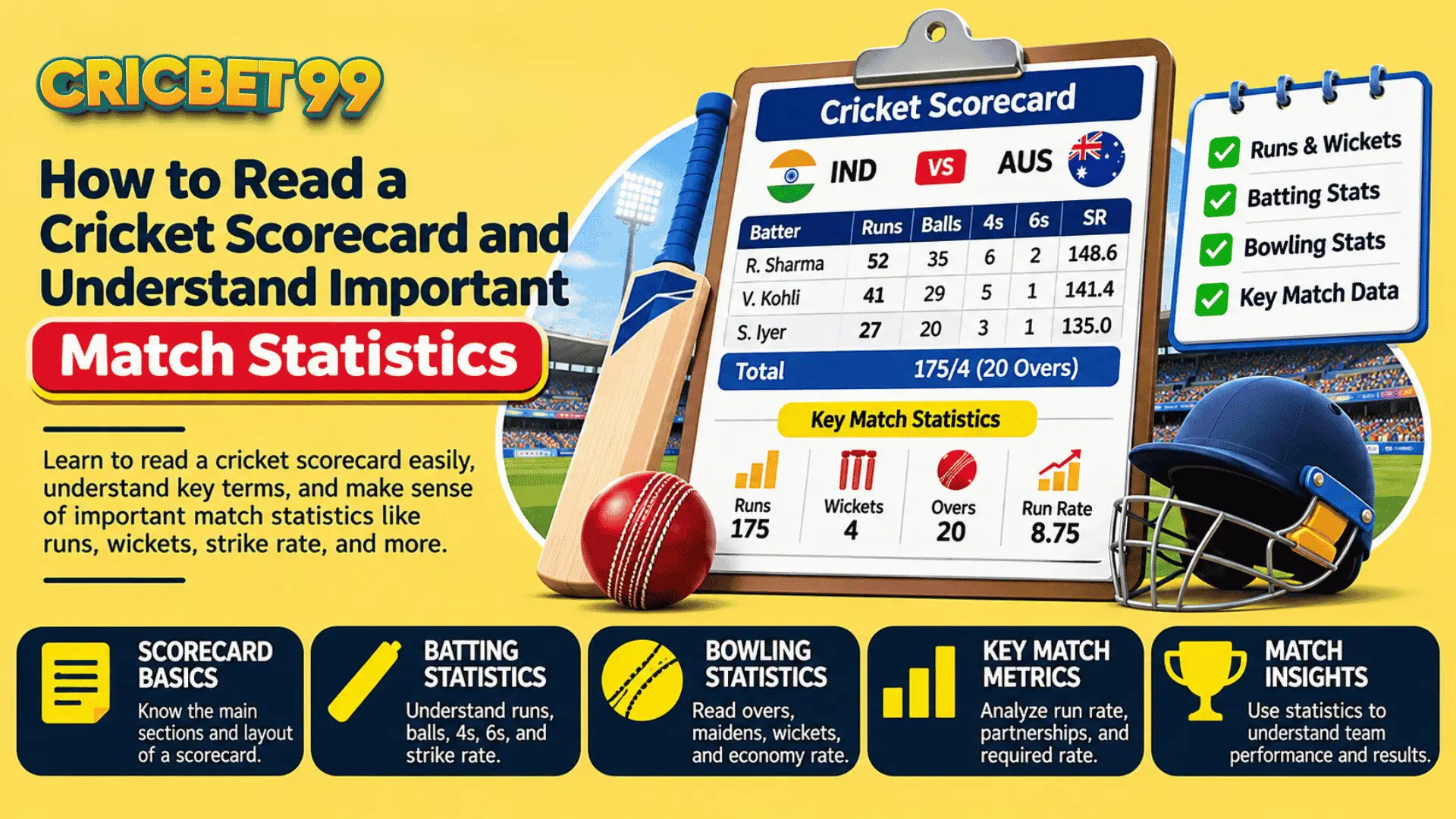
Learning how to read a Cricket Scorecard turns a page full of numbers into a clear story of any cricket game. All balls are placed on the match record, all runs are recorded, and all dismissals are permanently recorded. Once you understand the layout, you can decide who was more successful without watching a single ball live. In this guide, you will learn about cricket scorecard meaning, basic cricket statistics, Runs and wickets in cricket, and how overs help you interpret them.
Cricket Scorecard Meaning: The Basics
The Cricket scorecard meaning is an official summary sheet that reports all batting, bowling, and fielding activities in a game.
- The first step in learning basic: Cricket statistics for a match is to learn the normal cricket shorthand symbols which are written next to a player’s name.
- b (Bowled): Bowler bowled a legal delivery, resulting in the bails being knocked off the stumps.
- c (Caught): Ball caught before it has hit the ground by a fielder/keeper.
- lbw (Leg Before Wicket): When the ball comes into contact with the batter’s body before it reaches the stumps.
- st (Stumped): The batter ran outside the stumps, and the keeper broke the stumps.
Many fans use these real-time updates to interpret the changing dynamics of the game while watching live matches on 99 cricket.
The Team Score: Runs and Wickets in Cricket
In cricket, the first number that pops up on a scoreboard is runs, and the second number is wickets, and it’s in a simple format at the top of the board, such as 172/6 (or 6/172 in Australia).
- The batting team has 10 batsmen available, and have lost 6 wickets, leaving them with 172 total runs off that ball.
- Once you have learnt how to read a Cricket Scorecard, you need to analyse how scores of an innings determine the outcome of matches in various match rules.
- Teams win in multi-day Test Cricket by combining two innings of runs and need to get the opposition out twice.
- The innings will finish once 10 are bowled out or the maximum overs come to an end (all out).
- When a captain in a Test match wishes to get the opposition out (410/7d) after adding a few runs but giving himself time to bat and bowl.
When an attacking team completes their innings of a game when they need to cross the target (e.g. 173/4), the match ends at the lunch break.
Overs in Cricket: Understanding the Bowling Progress
Overs in cricket keep track of how many balls are bowled and how much time has passed in an innings, which consists of 6 balls.
- A partial over will be written with a dot notation, e.g. 16.4 overs, and can lead to significant confusion for newcomers.
- That number doesn’t refer to standard decimal math (16 and 4 tenths); it is actually meant to be 100 balls, of which 4 have already been hit.
- The subsequent legal delivery after 16.5 just steps the counter to 17.0.
- It is important to know how to read a Cricket Scorecard as well, as there are new methods employed in cricket scores across its three main formats.
- It is a type of limited-overs Cricket with only 20 overs (120 legal balls) per side, allowing for aggressive Cricket match statistics and fast scoring.
50 overs (300 legal balls) each side with equal measures of stability and having late swing. There is no limit on the number of overs per innings in Test cricket, and it may be played over a maximum of 5 days with 90 overs per day.
| Match Format | Maximum Overs Per Innings | Total Legal Balls | Typical Match Duration |
| T20 | 20 Overs | 120 Balls | 3 to 3.5 Hours |
| ODI | 50 Overs | 300 Balls | 7 to 8 Hours |
| Test Match | Unlimited (90 per day) | Unlimited | Up to 5 Days |
Reading the Batting Table and Cricket Match Statistics
| Bowling Column | Full Term | What It Tells You | Counts Wides/No-Balls? |
| O | Overs Bowled | Completed overs plus extra balls | No (must re-bowl) |
| M | Maiden Overs | Overs with zero runs conceded | Breaks the maiden |
| R | Runs Conceded | Total runs allowed by the bowler | Yes |
| W | Wickets Taken | Dismissals credited to the bowler | Yes (stumped/hit wicket) |
| ECON | Economy Rate | Average runs conceded per over | Yes |
When you realise that extras and partnerships make up the team total, it becomes easier to use Live Sports Betting tools.
Batting Strike Rate: Runs at a Glance
Batting strike rate shows how quickly a batter scores, scored in terms of runs per 100 balls faced.
- Batters can use the following formula to determine their Batting Strike Rate: Batting Strike Rate = (Runs Scored / Balls Faced) x 100.
- For example, if a batter scores 45 runs off 30 balls, their Batting strike rate is (45 ÷ 30) × 100 = 150.00.
- It is not necessary for a batter to hit 100 balls to record a strike rate; it is more a projection of the pace the batter is hitting the ball with.
- Learning how to read a Cricket Scorecard enables you to judge good or slow batting rates depending on the type of game.
- The SR (Strike Rate) of 85.00 – 100.00 in ODI cricket indicates great performance in the middle overs.
In Test cricket, patience is a far more important quality than speed; hence a Batting strike rate of 45.00 to 60.00 is very acceptable.
Reading the Bowling Figures and Overs in Cricket
The bowling end of the bowling table is directly under the batting side and records all the Overs in cricket bowled by the bowler in this innings.
- Overs (O): Total number of overs bowled by that player (e.g. 3.2: 3 overs and 2 balls).
- M (Maidens): Six-ball overs when the bowler did not concede a single run off the bat or from wides and no-balls.
- R (Runs Conceded): All runs scored by batters (along with wides, no-balls, etc.).
- W (Wickets): Bowlers’ contribution of wickets directly to their credit (bowled, caught, LBW, stumped or hit wicket, but not run-out); the bowler does not contribute to the run-out.
- ECON (Economy Rate): Average of the number of runs conceded per over bowled.
Wides and no-balls are applied to the bowler in terms of penalty runs and re-bowling the ball, providing more than six balls in an over in Cricket.
Bowling Economy Rate and Wicket Impact
Economy Rate—An average of how many runs a bowler is giving away per over.
- Bowling Economy Rate is calculated as: Bowling Economy Rate = Runs Conceded ÷ Overs Bowled.
- So if you lose 24 runs over 4 overs, then you have a Bowling economy rate of 6.00.
- Bowling with the figure of 4-0-18-0 (economy 4.50), Steve Burton tried to choke the pace, prompting the opposition to hit shots against teammates at the opposite end.
- On the other hand, the 4-0-38-3 record (economy 9.50) is a high-priced affair that missed some critical batting partnerships at the wicket of Runs and wickets in cricket.
Knowing the meaning of the different parts of the Cricket scorecard will help viewers make better predictions before finalising their Cricbet99 Login before the match.
How to Read a Cricket Scorecard for Smarter Match Analysis
Add batting and bowling numbers to identify actual turning points of any game. Refer to the bottom of the table (FoW) to find out each batter’s last score and over.
- For a second innings chase, calculate the “Current Run Rate” of the chasing team and compare it to “Required Run Rate” to see who has the advantage.
- Review the percentages achieved at the boundary (e.g. 4s and 6s) compared with Batting strike rate to determine whether a batter used power hitting or quickly running between the posts.
- Every time you find yourself reviewing Cricket match statistics to learn about the match, you’ll be using How to Read a Cricket Scorecard.
Check out icricbet99 for live cricket coverage, live match stats, and a one-on-one ball.
Conclusion
How to Read a Cricket Scorecard will make you fully aware of the different stages of cricket. Decoding cricket scorecard meaning, from abbreviations such as ‘lbw’ to understanding Runs and wickets in cricket, shows that every column gives insight into the scorecard, and that the forces get balanced between bat and ball. Go to cricbet 99 when a major match is playing and use these Cricket match statistics skills every over!
FAQs
1. What does an asterisk next to a batter’s score mean on a cricket scorecard?
If a batter is still at bat at the end of the game, there will be an asterisk next to the score (for example, 68). It serves as evidence that they continued to be at the crease when all 10 wickets fell, when the overs were concluded or when the team won the game.
2. Why does 14.3 overs mean 14 overs and 3 balls instead of 14.3 in decimal math?
In cricket, a ball can be sent into the stumps from 6 different points, not 10 different points. The numbers after the dot are a count of balls bowled, from ‘.1’ to ‘.5’ before it resets to the next integer.
3. Are extras like wides and leg byes added to a batter’s individual score?
No, the extras are just added to the total team tally and not towards any individual’s personal tally.
4. What is considered a good batting strike rate in T20 vs. ODI cricket?
A decent T20 strike rate ranges from 135.00 to 150.00+ in the short span of time available for batters to score 20 overs in a T20 match.
5. Does a run-out count as a wicket in a bowler’s scorecard figures?
No, the fielding team gets the run-out, not the bowler. It does not get scored in the bowler’s personal column, but affects the team’s rolls of wickets lost.
Read More:
https://icricbet99.vip/cricket-scorecard-guide-read-match-stats-now/
https://icricbet99.vip/cricket-player-performance-trends-stats-insights/